Author: Sachin Gupta | Find me on Twitter Follow @sach_gupta
Have any Questions? Tweet to @sach_gupta
Ok, everyone including the real estate developers, builders’ apex bodies such as CREDAI, brokerage houses, and other related industries are shouting from the roof tops for interest rate cuts to revive the demand in realty sector. Every time there is a review of monetary policy by RBI, numerous articles in leading newspapers are published on how the rate cuts can boost demand and bring back fence sitting customers in investing in real estate in India. However, RBI has resisted such calls and instead has focused on bringing down the inflation. Now that, inflation has come down, can we expect rate cuts? Mr. Raghuram Rajan knows it best. Let’s leave it to him and his team at RBI.
But, let’s explore, is there any merit in the builder’s argument for reducing the interest rates? Will rate cuts boost demand?
For that, we need to examine the housing price appreciation in various cities across India and the impact of repo rates on housing price appreciation.
Let’s go one by one.
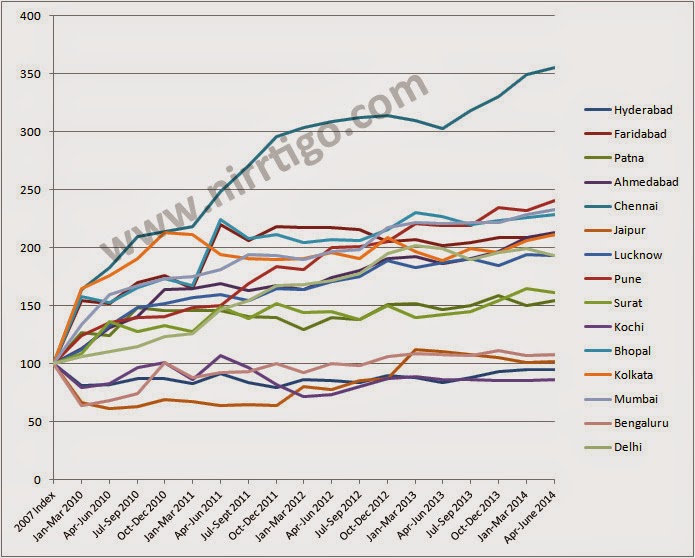
As can be seen from below graph, the pace of housing price appreciation has slowed down since 2010. What does it suggest? Well, it suggests, that demand has been falling gradually since 2010. End-users or investors are postponing their decision to invest in real estate. Assuming influx of new housing supply to be constant from 2010 to 2014.
Repo rates have increased from 5% in March 2010 to 8% now. Repo rates are rates at which RBI (central bank) lends money to banks or housing finance companies.

This graph tells the whole story. As the repo rates started moving up from 2010 to 2014, the housing price appreciation started to come down. In 2010, most cities witnessed substantial appreciation in housing prices with Bangalore, Ahmadabad, Kolkata, Mumbai, and Chennai appreciated upwards of 30%. Whereas in 2014, the highest price appreciation was witnessed in Pune at mere 3.88%.

While rate cuts will certainly bring back customers to market and we may see improved activity in real estate investment. However, just like demand waned gradually from 2010 to 2014, similarly, demand will pick up gradually and we may see the full potential somewhere in 2017.
Follow @sach_gupta
But, let’s explore, is there any merit in the builder’s argument for reducing the interest rates? Will rate cuts boost demand?
For that, we need to examine the housing price appreciation in various cities across India and the impact of repo rates on housing price appreciation.
Let’s go one by one.
- Appreciation in Housing prices across India
As can be seen from below graph, the pace of housing price appreciation has slowed down since 2010. What does it suggest? Well, it suggests, that demand has been falling gradually since 2010. End-users or investors are postponing their decision to invest in real estate. Assuming influx of new housing supply to be constant from 2010 to 2014.
- Increase in repo rates
Repo rates have increased from 5% in March 2010 to 8% now. Repo rates are rates at which RBI (central bank) lends money to banks or housing finance companies.
- Impact of increase in repo rates on housing price appreciation
This graph tells the whole story. As the repo rates started moving up from 2010 to 2014, the housing price appreciation started to come down. In 2010, most cities witnessed substantial appreciation in housing prices with Bangalore, Ahmadabad, Kolkata, Mumbai, and Chennai appreciated upwards of 30%. Whereas in 2014, the highest price appreciation was witnessed in Pune at mere 3.88%.
- Conclusion
While rate cuts will certainly bring back customers to market and we may see improved activity in real estate investment. However, just like demand waned gradually from 2010 to 2014, similarly, demand will pick up gradually and we may see the full potential somewhere in 2017.
Have any Questions? Tweet to @sach_gupta


