Showing posts with label How to enhance NRIs trust in real estate in India. Show all posts

Tuesday, January 17, 2017

Why 2017 is Likely to Be a Good Year for NRI Property Buyers

Non-resident Indians from all over the world have been fascinated with Indian real estate market. However, they are bothered by the lack of transparency and ways in which business dealings are conducted in India; especially when information is withheld deliberately from the buyers, and there is a lack of scientific process of due diligence. With several key policy changes in 2016 such as demonetization, Real Estate Regulation Act (RERA), the Goods and Services Tax (GST), and the Benami Transaction Act, the debate now is if the NRIs will be interested in investing in the nation.

Here’s why NRI property buyers should invest in Indian real estate in 2017:

Firstly, there are many ready possession properties built at prime locations such as Bangalore, NCR region, Chennai, etc. There are many luxury villas in Bangalore and 2 to 4 BHK apartments in NCR that are ready to be sold. Secondly, India is expected to keep its place among the fastest-growing economies in the world, with the real estate sector steering the wheel. Furthermore, policies like Goods & Services Tax, Real Estate Regulatory Act, Real Estate Investment Trusts, Benami Act, and demonetization are expected to bring about transparency in the sector. Lastly, the amended rules and regulations will ease up the purchasing process. Relaxation of laws by the Reserve Bank of India for NRI buyers is also a major benefit.

Naushad Panjwani, the managing partner at Mandarus Partners LLP, believes that the Indian realty has major credibility issues largely due to the absence of effective regulator, which is present in other sectors (TRAI, IRDAI, SEBI, etc.). He also believes that some other reasons that hold back NRIs to invest in India could be the shortage of funds for projects, the delay in the disposal of court cases, the lack of title insurance and nexus among politicians, developers, and bureaucrats. Panjwani says, “All of these factors kept good business houses away from the realty sector, and the industry as a whole was characterized by many unscrupulous elements. However, things have started to change slowly. The Real Estate Regulatory Act (RERA) and easing of inflow of funds in the form of Real Estate Investment Trusts, External Commercial Borrowings, and Foreign Direct Investment, have attracted the attention of reputed business houses and customers alike.”

The Chairman Emeritus of Sobha Ltd, Mr. PNC Menon believes that Indian realty sector has reached a stage where it offers NRIs a range of options to invest in, from affordable to mid-range to luxury properties. Menon said, "With greater transparency, tighter regulations, more affordability and enhanced price stability, Non Resident Indians will find interesting property investment opportunities, as long as they have a long-term view and are discerning about which realty project to invest in. India is a huge market with over 1.2 billion people and an emerging economy on a global front,”

Rustomjee Group’s brand custodian and chief customer delight officer, Mr. Kaizad Hateria has expressed his opinion that moves like demonetization will bring about transparency in the real estate sector and minimize unaccounted cash dealings. He said, “Greater transparency, will improve the element of trust in the Indian property market and this will make Non Resident Indians more confident about investing in properties in India.”

The marketing director of Sheth Creators, Hiral Sheth mentioned that realty sector has come a long way by becoming the second largest employer in India. Number of rules and regulations have been amended to ease the process of home buying as well as commercial property. Sheth said, “Factors like Foreign Direct Investment in the realty sector, relaxation of laws by the Reserve Bank of India (RBI) regarding property buying by Non Resident Indians and lenient policies via-à-vis the Foreign Exchange Management Act (FEMA), have accelerated real estate investments. Also, the availability of affordable properties, attracts a large number of urban Non Resident Indian buyers from across the globe.”

Industry experts believe that 2017 will be a good year for NRI buyers to invest in properties. New policies that will boost transparency and rules that will simplify the property purchasing process are the main reasons for attracting NRI buyers.

This is a guest post by Dinesh Dawde

Sunday, December 28, 2014

The process of an ‘NRI buying a piece of real estate in India’. Do's and Don’ts

Author: Sachin Gupta | Find me on Twitter

In our earlier articles about Non Resident Indians (NRI) and Person of Indian Origins (PIO) with regards to their investment in India, we covered, range of topics such as:

  1. Guidelines that an NRI or PIO must adhere to for selling, purchasing, and financing a property in India
  2. Taxation aspects for an NRI, PIO, or a Foreigner for buying an immovable Property in India
  3. Opening of NRE-NRO-FCNR-bank accounts in India to buy, sell, rent out immovable property?
  4. Reasons why NRIs prefer investment in Indian Real Estate
  5. Impact of falling Rupee on investment in real estate sector in India by Non Resident Indians


Having covered the above topics in details, we now move on to the process of an ‘NRI buying a piece of real estate in India’. If the process described below is followed diligently by an NRI investor, then investing in Indian real estate can prove to be rather rewarding.


  • Research
First thing first, before you embark on your journey to real estate investment in India, carry out comprehensive online research. How is the builders’ reputation in the market? Locality price indices, city master plan, infrastructure project announcements are some of the things that one should note down. Compare builders’ pros and cons, compare locality pros and cons, and assess the city master plan by visiting the urban development authorities websites. A number of online forums to discuss real estate projects are also available. Visit these independent forums and gauge what others are saying, ask questions if possible. 

  • Depute someone or visit the site yourself
“Pictures tell the story” is a proverb which maybe applicable to other sectors but not to real estate sector in India.  Many newly launched websites focus on ‘Real Photos’, but ask yourself, can they tell you the actual story? Can they show you the approach road towards the project? Can they highlight slums in the nearby areas? Can they highlight the construction quality? The answer is big NO. Therefore, when it comes to buying or renting real estate in India, visit the site yourself. With NRIs living in far away countries, it becomes difficult for them to visit the project site location. Instead, ask one of your friends or relatives to do this on your behalf. The bottom-line is ‘One should never rely on pictures shown in glossy brochures or websites’.

  • Check the bank approvals
Now, that you have zeroed on 2-3 projects after having done the online research and visiting the project site, the next step is to check the bank approvals. Which are the banks that have approved the project for home loan sanctioning? Kindly note, a bank or housing finance company invests about 70-80% of money in the project in form of home loans sanctioned to buyers. Therefore, they will definitely carry out proper due-diligence including the project approvals, clearances, title certificates, etc. Ask the builder about banks which have approved the project for home loan. Talk to these banks. Go ahead with project that has a minimum of 3 banks approving it for home loan.

  • Project approvals
Even though, you have got assurances from banks about project approvals, it doesn't mean that you turn a blind eye to check the approvals yourself. Ask the builder to show you the necessary approvals such as license number issued by Town Planning Department, approved drawings, NOC from various departments. This is to double check that everything is fine with the project and you won’t end up in a soup.

  • Ask questions
Be an extrovert buyer; ask questions to builders, banks, brokers. There is never a silly question. You would be investing a size-able amount of your money, therefore, be proactive.

  • Builder buyer agreement
In recent times, some of the major developers have landed in trouble with authorities and CCI for sticking to one-sided builder buyer agreement. Read the document carefully, and clarify things before you sign the agreement.

  • Hire a lawyer
Despite all the research, one can never be 100% sure. For this, the NRI investor can as well hire a lawyer to do the title verification. The lawyer will ensure that the builder has the ownership title to the land on which he is developing the project.

  • Never pay in cash
Whether one books property online or directly at the builder’s office, never pay in cash. Pay by cheque or via the formal routes such as online transfer. Keep receipt of every payment you make to the developer.

Happy investing :)
Do share if you liked the article!


Have any Questions?

Monday, March 3, 2014

Will falling Rupee lead to investment in real estate sector in India by Non Resident Indians? How can property developers tap this?

Author: Sachin Gupta | Find me on Twitter

Data Source: Reserve Bank of India, Ministry of overseas affairs

The Indian Rupee has fallen substantially against US dollar, and other international currencies. The value of one US dollar was Rupees 53.289 in Jan-2013, whereas in Jan-2014 it stood at 62.4768. It’s a fall of whooping 17.24% in one year, reaching a low of Rs. 69 odd.

During the course of this one year, at one point of time in August 2013, the rupee stood at 66.5742 against 1 US $. If not for the measures taken by RBI and finance ministry, the free fall of rupee would have continued. Exporters were happy but importers were crying and this had an adverse impact on current account deficit because of India being a net importer country.

Here is the sharp fall of rupee against US dollar in last 6 years.


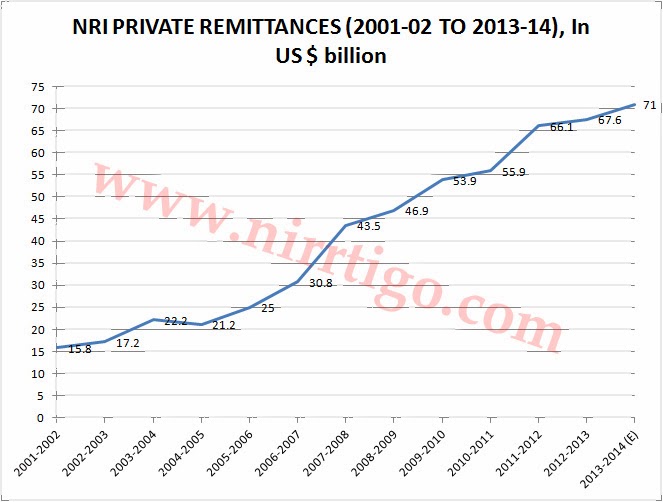
Now, the question to be asked is if the fall of rupee results in increase in NRI remittances to India? And the answer is resounding ‘YES’. According to World Bank report, in 2013 international migrants (NRIs) will remit $71 billion of their earnings back to India, highest among all developing countries. "With the weakening of the Indian rupee, a surge in remittances is expected as nonresident Indians take advantage of the cheaper goods, services and assets back home.

Here is a look at what NRIs are remitting back to India on a yearly basis:


Now, the second question to be asked is, where is all this money going to? Is an NRI buying Property in India, or investing in NRE/NRO accounts, or investing in capital markets, or bond market, or in entrepreneurial activities? Although, there is little segmented data with regards to the share of each asset class, a quick look at the RBI database highlights that NRE/NRO accounts are the preferred choice by Non Resident Indians.

As per the RBI definition, Non-Resident Ordinary Rupee Account (NRO Account) may be opened / maintained in the form of current, savings, recurring or fixed deposit accounts. NRI/PIO may remit from the balances held in NRO account an amount not exceeding USD one million per financial year, subject to payment of applicable taxes. The limit of USD 1 million per financial year includes sale proceeds of immovable properties held by NRIs/PIOs. NRO (current/savings) account can also be opened by a foreign national of non-Indian origin visiting India, with funds remitted from outside India through banking channel or by sale of foreign exchange brought by him to India. Whereas Non-Resident (External) Rupee Account (NRE Account) may be in the form of savings, current, recurring or fixed deposit accounts. Such accounts can be opened only by the non-resident himself and not through the holder of the power of attorney. Accrued interest income and balances held in NRE accounts are exempt from Income tax and Wealth tax, respectively.

Whereas as per RBI definition; Foreign Currency Non Resident (Bank) Account – FCNR (B) Accounts are only in the form of term deposits of 1 to 5 years. All debits / credits permissible in respect of NRE accounts, including credit of sale proceeds of FDI investments, are permissible in FCNR (B) accounts also. Account can be in any freely convertible currency. Loans up to Rs.100 lakh can be extended against security of funds held in FCNR (B) deposit either to the depositors or third parties. The interest rates are stipulated by the Department of Banking Operations and Development, Reserve Bank of India. When an account holder becomes a person resident in India, deposits may be allowed to continue till maturity at the contracted rate of interest, if so desired by him.

There could be various reasons for preference of NRE/NRO accounts by NRIs ranging from volatility in stock markets, risks involved with entrepreneurial activities, low yield on bond market, relative safe nature of NRE/NRO accounts, and poor execution by real estate developers of their projects.


Why is real estate market in India not being able to attract NRI money to ease the current liquidity pressure? Our team debated on this issue and came out with 4Cs.


Cost - No Escalations – costs escalations during the course of the project construction has been a key detriment for NRIs wherein it has been noted that real estate developers escalate the cost of the project arbitrarily on account on various parameters such as rising labor cost, regulatory cost, and raw material cost. Why do we still observe a builder asking for additional funds from buyers for parking slots, development charges, and so on when those were not included in the builder buyer agreement at the time of selling of the project inventory? Why can’t there be transparency as far as project pricing is concerned? There needs to be more transparency in builder-buyer agreements.

Commitment to timeline – It is a common practice that developers sell their projects by claiming that they will deliver the housing units in 36 months at the time of agreement between them and the buyer. And yet, we have noticed umpteen numbers of cases where projects have been delayed by not just by 1 year but by more than 2-3 years. And in some cases, project delays have stretched to 4 years. Why can’t developers stick to their promise which they had made at the time of agreement? Or else, simply state the time it will take to develop the project (say 5 years). This matter needs to be addressed directly in contractual terms or through legislation.

Construction quality – With NRIs living in different parts of the world, it becomes difficult for them to verify the construction quality of the project? What are the construction materials being used? Will the specifications and amenities be as per the builder buyer agreement? To overcome this, a 3rd party periodic construction quality check can be brought in.

Carpet area to sale-able area ratios – maintain a transparent mechanism to calculate carpet area and sale-able area. This is a regulatory function, that authorities need to address. 

Along with the 4 'C', An NRI also worries about who will manage or take care of his/her Property? Sumit Bhargava bought a 3 BHK in Gurgaon, but he had to relocate permanently to UK for his work. Since, there were no Professional Property Management Company in Gurgaon, Sumit eventually sold his apartment at lower rates.

It is widely believed that if real estate developers can focus on these 4Cs, then there is absolute certainty that NRI money will flow in property sector in India at a scale unprecedented in real estate history of India and eventually it can ease the pressure of liquidity on real estate developers, and for that matter speculators, investors, banks, and other financial institutions that finance this huge economic activity.

Are the developers listening??? Real estate developers can reach our team of professionals for advisory at nirrtigo@nirrtigo.com


Data Source: Reserve Bank of India, Ministry of overseas affairs


Create your free online surveys with SurveyMonkey , the world's leading questionnaire tool.

Appendix – I
As per the May 2012 estimates by Ministry of Overseas Indian Affairs, the population of Indians living abroad is 21.91 million. However, more than 50% of them live in high income countries and have been the major contributor to NRI money flowing in India. We present below the overall break-up of population of Indians living in high income countries:

  • United States of America (USA) – 2.25 million
  • United Kingdom (UK) – 1.5 million
  • United Arab Emirates (UAE) – 1.75 million
  • Singapore – 0.67 million
  • Saudi Arabia – 1.79 million
  • Malaysia – 2.05 million
  • Canada – 1 million
  • Australia – 0.45 million
  • And in other countries across the globe – 10.45 million

Total Population of Indians living abroad– 21.91 million


Have any Questions?