Monday, August 11, 2014

Furnished Office Space 15000 Square Feet on Golf Course Road Gurgaon for Lease

E-Commerce, IT/ITES, Consulting, Banking & Insurance, Other financial services, or Companies looking to set up their Head Office in Gurgaon have an opportunity to lease 15000 Square Feet of A-Grade Office Space at highly attractive rental and terms. The Office space is fully furnished & ready to move and offers following amenities:


  • 170 workstations
  • 15 cabins
  • 1 Cafeteria for 35 persons
  • Separate toilets for Ladies/Gents/Directors
  • 15   reserved car parking space
  • 100% Power back up
  • Conference hall for 50 persons


This fully furnished office space on 3rd floor with a super area of 15000 sq ft is located on one of the most prime location at Golf Course Road, Sector 53 in Gurgaon.


Office Space Details:

FLOOR : 3rd Floor
COVERED AREA : 15007 square feet
ELECTRICAL SANCTIONED LOAD :  75 KW
HVAC CAPACITY :  66.5 TR
POWER BACK UP :  Available with DG
CABINS :  15 
TOILETS :  3 Gents, 3 Ladies
CAFETERIA :  1 (35 People)
NO. OF CAR PARKING :  15


Plan:


For more details:


or Write to us at nirrtigo@nirrtigo.com

Thursday, August 7, 2014

Pune Real Estate Trend 2014

Gera Pune Realty Report January 2014 to June 2014 revises price increase expectations of the Pune realty market for 2014 to be in the region of 10% to 14%

  1. The half yearly price increase has been at the lowest in years at 2.2% 
  2. Pune realty market has expanded by only 22% in the calendar year June 2013 – 2014 as compared to 31.9% in the corresponding period of June 2012 - 2013
  3. The average price across the city is pegged at Rs. 4910/- per square foot 
  4. Inventory has reached an all-time high of 66,279 units which translated into 29% increase over the past year


Pune, August 6, 2014 - Gera Developments, one of the pioneers of the real estate business in Pune and the creators of premium residential and commercial projects in Pune, Goa and Bangalore released the Gera Pune Realty Report for the period January – June 2014. The consolidated report which is now an industry benchmark presents a detailed update and analysis of the Pune real estate residential market. The current report reflects that the impact of the overall economic slowdown has finally started showing on the Pune real estate numbers over the last 6 months and clearly indicates that the same has had a bearing on the demand in the market place. The assessment of the overall gross stock (defined as projects under construction and ready projects with more than 5% unsold stock and more than 10 units) reveals that the rate of market expansion has come down in the last 12 months i.e. June’ 13 to June’ 14. This period saw the gross stock rise from 200,944 units to 245,674 units, an increase of 22% as compared to the preceding 12 months from June ’12 to June ’13 which saw stock rising from 152,311 units to 200,944 units, an increase of 31.9%.

The half yearly price increase has been at the lowest in the years at 2.2% for the period January’ 14 to June’ 14. There is however a counter effect of increased loading and extra charges that has, to an extent added to the price rise but does not show up in the normal analysis. The average price across the city is now just shy of Rs. 5000 psf and stands at Rs. 4910 psf. The average basket of homes has delivered a 41.29% increase in rates over the last 3 years where average prices in June 2011 were at Rs. 3475 psf.  The 3 year compounded annual growth rate has been 12.25%. Investors who have purchased homes 3 years ago with mortgage rates at 10.5% and loan to value of 80% would have seen an equity returns of 18.75% per annum, making real estate still an attractive investment especially when factoring in tax benefits and deducting entry load costs.

Commenting on the key findings of the Gera Pune realty report, Mr. Rohit Gera, Managing Director, Gera Developments said, “We have studied and evaluated the Pune realty market to realize that on the surface there seems to be a slowdown in the rate of increase of realty prices. However the quantum of slow down needs to be viewed with total cost of purchase rather than the traditional rate per sq. ft. model that has been used to value property. The loading of the common areas onto the carpet area is in the region of 33% to 35% for the common areas.  This has had an impact of 8% - 10% on the carpet area or 5% - 7% on the saleable areas. The increase in the extra costs like club house charges, infrastructure etc. has risen more than the rates themselves thereby having a positive impact on the overall cost that the consumer pays for the home.”

Mr. Gera further added “We have gauged the market in terms of supply and unsold stock based on the category of housing. The categories we have created are Budget, Value, Premium, PremiumPlus & Luxury. These parameters have helped us to understand that the maximum stress is on the luxury segment (where current quoted prices are in excess of Rs. 7500 psf) which has seen a 61% rise in unsold stock in the last 12 months. This segment is most exposed to the vagaries of the economy which has resulted in to a deferment of purchase. Also customers seem to have found greater value in the prices between Rs. 6000 and 7000 psf.”

For today’s buyer there may appear to be a slowdown in the increases in rates over the past years, however it is interesting to note that the rate of increase in luxury specifications and amenities has only increased. Locations where Italian marble or home automation would have been considered extravagant a year ago, now have a number of projects offering higher better specifications and amenities.  All these amenities end up costing the developer but are provided in a hyper competitive market. The boost to infrastructure and civic amenities  have provided customers with a better bargain since homes are actually getting cheaper in real terms with lower rates of appreciation, adjusted for infrastructure, better specifications and amenities. Though the additional loading and extra costs have impacted the overall prices, customers continue to look at the cost per sq. ft. and as such, feels satisfied that the rates have not risen. In reality, the overall cost of ownership has increased over the last few years.

While commenting on the price outlook, Mr. Gera explained that, “Our previous price outlook had indicated an increase of 13% to 18% for the year 2014. The first half of the year has shown a mere 2.2% increase.  Keeping this in mind, we would like to revise our outlook for the future and would recast price increase expectations for the upcoming 12 months to be in the region of 10% to 14%.”

The increase in inventories has also continued with unsold inventories at an all-time high – the unsold inventory that was at 39238 units 24 months ago increased by 30.9% to 51363 units 12 months ago and currently stands at 66279 units, an increase of 29% over the past year. On a macro level, areas like Chakan and Kondhwa saw the most infusion in terms of new supply, followed by Wagholi and Pradhikaran region of PCMC. City center, Vimannagar, Erandwane, Kothrud & Karve Nagar witnessed the maximum price appreciation in the last 24 months while Sopan Baugh, Khed, Aundh and Koregaon Park witnessed the lowest price appreciation owing to the saturation in those micro markets.


SUMMARY
Years of the economy slowly grinding to a halt has finally seen the impact on the real estate sector.  While there is a renewed sense of optimism in the air, the same has not translated into demand into the market place as yet.  This enhanced demand when triggered has the potential to create an upward pressure on prices as seen in the earlier years.

The counter effect to increasing prices is the hope that that simplified procedures with reduced red tape will improve the supply into the markets thereby keeping prices in check. The question of the timing of these two significant developments will determine the impact on prices.  The more likely outcome seems to be that the optimism will turn to demand sooner than the simplification of processes and reduction of red tape.


About Gera Developments
Gera Developments, one of the pioneers of the real estate business in Pune are recognized as the creators of premium residential and commercial projects in Pune, Goa & now Bangalore. Gera Developments has recently unveiled ChildCentricTM Homes, a new way to live for today’s young home buyer. It is a revolutionary concept and an innovative solution that is set to create a new category in the residential real estate industry and establish a benchmark in the product + services model.


Find the detailed Pune Real Estate Report below:


Pune residential realty report for the period January to June 2014 from Green Realtech Projects Pvt. Ltd


Appendix:

Demographic Projections for Pune Municipal Corporation, 2001-2027

Pune's Population Projections:

Year Population
2001 1855476
2007 2138243
2012 2371663
2017 2650482
2022 2975720
2027 3356121

Saturday, August 2, 2014

Bloomberg TV India to launch “Tracking the Recovery – Real Estate”

Press Release:


~ First of its kind show that is all set to be the final world on India’s Real Estate story ~


Mumbai, 1st August, 2014: Bloomberg TV India, the nation’s leading English business news channel, is launching the first of its kind show - Tracking the Recovery - Real Estate.  The on-air series will put the spotlight on the road to recovery and analyse the triggers of the industry’s growth by engaging industry stalwarts in a series of exclusive round table discussions. The show will also rank India’s most successful real estate firms.

The realty sector in India is upbeat about Finance Minister Arun Jaitley’s Budget promise to provide incentives for the establishment of Real Estate Investment Trusts (REIT). This has sent, the stocks of real estate developers soaring high, continued improvement in the overall macro-economic scenario; both telltale signs of the real estate sector coming back on track.

The Indian real estate sector has enormous potential at churning out huge revenue and contributing to the country’s economy. Yet, the sector has to overcome a lot of challenges in order to move ahead and be stable. Tracking the Recovery – Real Estate, will help one understand the challenges faced by the real estate industry as well as the means to clear the roadblocks in its path.

Mr. Lavneesh Gupta, COO, Bloomberg TV India said, “Tracking the Recovery – Real Estate, promises to serve as a reality check for the Indian real estate market. Our efforts will be to focus on the larger issues around the real estate industry and its future growth, as the country’s best thought leaders highlight the growth triggers and map the sector’s road to recovery. Taking into consideration our position, as a responsible business news channel, we will present an up to date analysis on an industry that contributes to the development of the economy.”

Tracking the Recovery – Real Estate, will be a five-part series comprising of panel discussions with the best minds in the sector, on a single platform, to be held in Mumbai and New Delhi. These discussions will involve industry chiefs and thought leaders from the real estate sector, telling it as it is, to help you get real with realty. The panels will be moderated by Ms. Mini Menon, Executive Editor – Bloomberg TV India.

“Tracking the Recovery - Real Estate” will air exclusively on Bloomberg TV India, in the month of August, 2014.


About Bloomberg TV India:

Bloomberg TV India, nation’s leading English business news channel with unique access to newsmakers and research-based data, illuminates stories that affect companies and industries. Bloomberg TV India provides immediate perspective on critical business news as it happens, from where it happens. Backed by an enviable squad of Indian journalists, global network of 150 bureaus and 2500 professionals, we deliver the most credible insights to our viewers. 

Bloomberg TV India’s focus on delivering breaking news and key insights aligns with Bloomberg's overall goal of being the world's most influential news organization. The core of the channel’s viewership is formed by influential leaders, business executives, and affluent professionals.

Friday, August 1, 2014

Service Tax on Under Construction Property in India

Author: Sachin Gupta | Find me on Twitter

Whenever a builder sells an apartment in an under construction project to a home buyer, the builder is said to be rendering the construction service to home buyer and therefore, service tax is levied.

The service tax is levied only on under-construction property and not on completed property. An under-construction property is one which is still not complete and the completion certificate of such a property has not been received from relevant authority (Local Municipal body or development authority).

Therefore, it becomes mandatory for the builder to collect service tax from the buyer and deposit it with the service tax department.

Budget 2010 brought Abatement Scheme, under Notification No. 1/2006 dated March 1, 2006, which provides that the contractor is entitled to claim abatement to the extent of 67 per cent of the value of services rendered by him. Hence, the net effect of the tax could be lesser than the 3.4 per cent, since construction attracts service tax only on 33 per cent of the value. In the 2010-11 budget, the Finance Minister rolled back service tax to 25 per cent of the value.

So, essentially, the service tax is levied on 25% of the gross value of the property. In other words, 3.09 % will be the effective rate of service tax on under construction properties in India.

Service Tax – 12.36 %
Abatement – 75%
Service Tax applicable on under-construction property – 25% x 12.36% = 3.09%


One can also find out the Total Property Buying Costs in India.

For more on Service tax on under construction property, read the below document:


Have any Questions?

Thursday, July 24, 2014

Noida Extension in the fast track of realty development

Noida Extension part of Greater Noida (part of the state of Uttar Pradesh) has come under the realty radar. The four sectors which comprise of the Noida Extension are governed by the Greater Noida Development Authority. This area was essentially dedicated to affordable homes but things are starting to change now. Noida Extension will be transformed into a new residential hub in the National Capital Region. Several new projects are launched in the area getting a good response from residents in and around Noida Extension. The Dadri Main Road connecting Noida Extension provides better connectivity along with the upcoming expansion of the metro in the National Capital Region. The area is mostly occupied by small scale and medium scale industries. In terms of social infrastructure, the area has a good stronghold with a number of entertainment avenues.

In the year 2011 we saw 2.5 lakh homes launched here out of which 1.5 lakh homes were bought in the pre constructions stage itself. The construction work came to an abrupt halt with the farmer protesting on land acquisition issues. However this has been resolved now. Property in Noida Extension turned out to be a good investment option after all.


“The housing demand in Noida Extension is going to be very high after National Capital Region Planning Board (NCRPB) approval, while supply is very weak. Prices are bound to increase because of various factors such as hike in compensation to farmers and rising input cost. Prices were Rs. 2,100-2,200 a sq ft in this region last year. Now we expect the same to go up to about Rs. 2,600 per sq. ft. “Amrapali Chairman, Anil Sharma told PTI.

However if you look at flats for sale in Noida, they do not fall under the affordable housing bracket anymore. With the increase in land acquisition cost and construction cost including cost of raw material in the recent past, builders are struggling to deliver the dream of affordable housing to the common man. "We were selling homes at Rs. 2,300 per sq ft in May last year when farmers protest started on land acquisition issue. Now, we will launch projects at Rs. 3,200 per sq ft in Noida Extension," R K Arora said, Chairman Supertech said to NDTV Profit.

"This area has been considered as region of affordable homes. Lot of burden has to be borne by the developers. So there will be little bit of price increase," JLL India CEO (Operations) Santosh Kumar said to NDTV Profit. With the steady increase in demand, prices of property in Noida Extension are said to go up. This will further affect the current scenario including the purchasing power of an individual.

Today Noida Extension is planned by the development authorities in such a manner that it has become a haven for urban dweller. The prices are still comparatively lower compared to the rest of the National Capital Region. Following the PPP Model – Public Private Partnership, the development authorities need to chart out future infrastructure developments here.


This is a guest post by Sulabha Kulkarni who is a freelance writer and an avid blogger. Her areas of expertise are finance and real estate sector in India.

Monday, July 14, 2014

What are the key takeaways for real estate sector from Indian union budget 2014?

Author: Sachin Gupta | Find me on Twitter

Last week in India was all about union budget. Since the new Modi Government came into power in Delhi, most political and economic commentators were looking forward to the Budget 2014. The media and and coffee shop discussions were all about speculating and making projections as to what will or not be included in Minister Arun Jaitley's maiden budget. The budget, which is expected to signal the dawn of socio-economic revival or “acche din” by Modi Government, was the most talked about event.

Railway budget 2014 was presented first, and then the general budget. While the industry has welcomed the budget presented by union finance minister Arun Jaitley, the opposition has slammed it. However, with this budget, one thing is given, that a common man will be able to save more. And these savings when circulated in the eco-system can boost investments and thereby GDP growth.

Among all the sectors, it seems, real estate sector was given maximum attention by Finance ministry. There were slew of measures to revive the sector and boost the confidence of both home buyers as well as real estate developers.

What are the key takeaways for realty sector from union budget 2014? Here we present them.


  • Tax relief available for housing loan interest payment

We all know that home-ownership continues to be the lifelong dream of most middle class and lower middle class people in India. And financing this dream has become expensive due to high interest rates. While, interest rates are not the domain of Finance ministry, the ministry has increased the deductions on interest on home loan from present Rs. 1.5 Lacs to Rs. 2 Lacs. How does this help the buyer? We present the explanation below.

If Gross Income Rs 9 Lacs If Gross Income Rs 15 Lacs
Before Budget          After Budget   Before Budget          After Budget
Gross Total Income 900000 900000 1500000 1500000
Less Interest Paid on Home Loan 150000 200000 150000 200000
Gross Taxable Income 750000 700000 1350000 1300000
Less Deduction under Section 80C 100000 150000 100000 150000
Total Taxable Income 650000 550000 1250000 1150000
Tax Payable 60000 40000 205000 175000
Education Cess 3% 1800 1200 6150 5250
Total Tax Payable 61800 41200 211150 180250
Savings 20600 30900


  • Relaxation in FDI for real estate sector

With a view to catalyze investments in development of townships and infrastructure, 100 per cent FDI is allowed under the automatic route in townships, housing and construction development projects and hospitality sectors such as residential complexes, shopping centers, malls, multiplexes, Cineplex’s, commercial offices, hotels/service apartments, resorts, hospitals, educational institutions.

Prior to budget 2014, the FDI in real estate sector in India was subjected to certain conditions.
    • Minimum area requirements, in case of
      1. Development of serviced housing plots - 10 hectares.
      2. Construction-development projects - built-up area of 50,000 sq. mts.
      3. A combination project, any of the above two conditions will suffice.
    • Investment
      1. Minimum capitalization for wholly owned subsidiaries - US$ 10 million; for joint ventures with Indian partners - US$ 5 million, to be brought in within 6 months of commencement of business.
      2. Original investment cannot be repatriated before a period of three years from completion of capitalization.
      3. The investor may exit earlier with prior approval from Foreign Investment Promotion Board (FIPB).

Post Budget 2014, some of these conditions have been relaxed. The relaxed conditions are:
    • Minimum area requirements, in case of
      1. Construction-development projects - built-up area of 20,000 sq. mts now from 50000 sq. mts.
    • Investment
      1. Minimum capitalization for wholly owned subsidiaries - US$ 5 million now from US$ 10 million.

These relaxations will hasten the growth of real estate development in tier 2 and tier 3 cities, because with new rules, small scale developers can also have access to FDI.


  • Incentives for Real Estate Investment Trusts (REITs)
Real Estate Investment Trusts are investment vehicles which are used to pool in investments from retail investors and the money is invested in real estate projects with steady stream of rental income. REITs are successfully used in many developed and developing countries. Mr. Arun Jaitley has announced that REITs will qualify under certain tax provisions to become a pass-through entity that distributes to its shareholders substantially all of its earnings in addition to any capital gains generated from the sale or disposition of its properties.

This will ease the pressure on banking system and provide liquidity for the real estate sector. 


  • Focus on affordable housing
With the objective of providing housing for all by 2022, the government has increased the Rural Housing funds allocation to Rs. 8000 crore for this financial year. At the same time, Rupees 4000 crores have been provided to National Housing Bank (NHB) to provide cheaper credit for the urban households belonging to low income groups.

All of this will add substantial value to the development of affordable housing in financial year 2014-15.


  • Development for 100 smart cities
This is a long term vision and by allocating the corpus of Rupees 7060 crores, Finance minister has set the stage for improvement of infrastructure in Indian cities. While, it may take years to realize the development of 100 smart cities, but nonetheless, it is a welcome step. It has been argued that the allocation is paltry in relation to the levels of investment required to realize a Smart City. Minister Jaitley's speech was marked by a silence about raising investment in this sector through the Public Private Partnership (PPP). Overall, this move signifies a positive intention in the right direction.


Have any Questions?

Friday, July 11, 2014

Affordable Housing Projects on a Rise in India

In the recent past, affordable housing projects are on the rise in India. The government has also taken several measures in order to promote affordable housing. The following post explores the same.


  • Introduction

India has been a land of stark contrasts when it comes to the real estate and property market. At one side, impenetrable metro areas have witnessed some of the highest property rate increases and have attracted new dwellers from all over the country; on the other side, the overall property trends for the country have experienced a much lower uniform growth and investors have been complaining that they are not getting expected returns on the money that they put in the real estate market.

Despite the apparent slump in the property market for high-end housing projects, builders and development companies working in the low income housing sector have reported great sales and returns. Through special packages, attractive pricing, and targeted focus on mid-level income groups, these developers have ensured high sales and have created so many great options for investors pan India that they are at times confused over which package would offer them the best deal. The initiatives by the central government have also considerably aided these changes and made affordable housing more popular.

  • An urge by the central government for increased focus on affordable housing

The market may have become saturated for luxury and high end segments, but the affordable housing segment is not just on a high, it is experiencing a boom. Simply designed, high quality homes that are aimed at low income groups, and offer buyers a lot of flexibility when deciding a payment plan are a huge hit and have made the builders in this segment very happy. For example, in Chennai, with an advance payment of as little as INR 1.25 lakh some builders will offer you a  new home.

M Venkaiah Naidu, the Minister of Urban Development and Housing and Poverty Alleviation, has asked banks across the country to make it easier for people with low income to get financing for home loans in a simpler manner. He also issued an expeditious completion order to the various builders involved in affordable housing projects, and made it their top priority.


  • Affordable Homes on the Rise
The push by the central government towards an increase in affordable housing is not just for a few cities, but for the country as a whole. The urban poor in particular, slum dwellers and people living on rent should have increased access to cheaper homes, and the government is trying to make sure that this happens.

Of late, the Bangalore property market has also witnessed the launching of affordable homes. Several builders are investing in new projects that belong to the affordable category. Needless to say, an increased demand has been witnessed in this particular segment. Real estate developers like Tata Housing Group and Provident Builders have already forayed into this segment. Welworth City at Doddaballapur, is the first flagship affordable housing project in Bangalore.

On the other hand, Tata Housing is all set to launch its maiden affordable housing project under the banner New Haven. Managing director and chief executive officer Brotin Banerjee, of Tata Housing said in a statement, “Envisaging a rising demand for affordable homes with premium facilities in the Silicon Valley of India, we are pleased to bring this iconic and successful affordable housing brand for the people of Bangalore”.

Localities in Bangalore where affordable homes are on the rise are Mysore Road, Hosur Road, Kanakpura Road. Investors are targeting these areas to build affordable housings.

Kerala has sanctioned a sum of INR 14.59 crore for the development of homes intended for the individuals and families belonging to low income groups. Tamil Nadu is also experiencing a high, with the Chennai-Vizag industrial corridor, and that will bring in a new wave of affordable housing projects. Chennai in particular has already several such projects underway, with some builders offering homes at prices as low as INR 18 lakh.

Industrial development schemes are also expected to close the gap between the number of people living in the low income bracket, and the affordable housing projects that are available to them.  With thousands of workers who will need affordable homes close to the new factory and plants that will open up, the demands for homes that offer quality at a low price will also rise exponentially.


  • Schemes available for individuals falling in the low income bracket
M Venkaiah Naidu,  has asked the banks to make it more attractive for individuals belonging to the low income bracket to apply for home loans. He also requested that the process be made simpler. A central bank that governs property development across India is needed, and Naidu says that either the NABARD will need to have its jurisdiction extended, or an alternate organization like the SIDBI will have to take up this new role. Schemes that encourage builders to use new technologies have also been discussed, and construction tools like gypsum boards are expected to be used to make these homes, ensuring the quality in the construction work, while bringing down the overall costs even more:

  1. Banks to make home loans more attractive for low income groups
  2. A central body to be put in place for managing development of affordable housing pan India
  3. Use of newer technology in construction to be encouraged in order to reduce costs

  • Price trend for affordable housing projects
Low income houses across India are becoming even more affordable. Newer construction technologies reduce the cost of building a home, sometimes by as much as half. The average cost of building a house will now be closer to Rs 900 per square foot, as opposed to the normal Rs 1500 per sq foot. Combined with the government plans that will provide builders, land at subsidized rates, affordable housing is expected to become a lot more affordable.


This is a guest post by Puspashree Mohanty


Monday, June 30, 2014

Another building collapsed in Chennai, India. What could be the causes of building collapse at such regular intervals in various Indian cities? Who is responsible for illegal and low quality construction? What can home buyers, municipal body, and builders do to stop illegal construction and low quality construction in India?

Author: Sachin Gupta | Find me on Twitter

June 28, 2014 was a disastrous day in Chennai. A 12-story building named ‘Trust Heights’ under construction collapsed in heavy rain in Moulivakkam, Porur. Officials confirmed that 14 people had died amid fears that the death toll could rise as many others remained trapped under the debris. Tamil Nadu chief minister J Jayalalithaa visited the site on Sunday, June 29, 2014 and ordered a thorough probe. Reason for building collapse has been cited as ‘structural defects’.

Police have arrested six people, including promoters and employees of ‘Trust Heights’ developer Prime Sristi Housing Pvt Ltd, Madurai, in connection with the collapse.

Well, this was Chennai. But this has been happening in the country for far too long and at far too many places. In recent months various buildings have collapsed in Thane, Mumbai, Delhi, Goa, and host of other cities. Did anything change? Did local municipal bodies or town planning departments bring in new laws? Well, given the current state of inefficient and colluding bureaucracy, we can’t expect much from the babus.


What are the causes of buildings collapse at such regular interval across various Indian cities?

What could be the causes of building collapse at such regular intervals in various Indian cities? There are many theories going around and one among them is the use of sub-standard material in building construction. However, if one digs deep, then it can be safely said that most of these collapses happen because of corruption. It is now commonly believed that builders flout building codes by paying bribe to babus of governing authorities.

Take the case of Campa Cola compound in Mumbai where illegal floors were built in 1980s. The recent DLF case in Gurgaon is also a prime example of illegal construction. There are many such cases where builders and babus have colluded to maximize their gains. And there is no way that these people will care for the plight of common man and workers working on these building sites. Bottom-line of their balance sheet is what they are worried about. Well done!

Home buyers also overlook the construction quality part. Because of soaring real estate prices in metros, home buyers tend to buy whatever is served on their plate and thereby a compromise on construction quality is made. So, there is no bottom-up pressure on authorities and builders from the home buyers. And things continue to drift along like this. One building collapse here and one building collapse there…its ok, it happens. Phew…


Who will be penalized?

Well, now that, this builder in Chennai has been arrested, he and his associates may be penalized. But is this the solution? Will this penalty make sure that no such future mishaps happen? What could be done to eliminate such instances?


Solution:

We are not experts in building construction codes. We are just creating awareness through this article about the urgent need of overhaul of construction practices in India.
  • Things that a home buyer can do:
    1. It is impossible for an individual buyer to conduct construction quality check of a project he/she has invested in. However, when you buy an under construction home from the real estate developer, a few unannounced visits to the construction site will help you understand the quality of construction.
    2. Ask for a copy of soil test report from the builder – Before construction, all builders will conduct soil test. You as a home buyer should be extrovert enough to ask for the soil test report. This soil test report will ensure that building is not standing on a shaky ground. Maybe poor soil condition could be the reason that this building in Chennai collapsed. So, insist on this report from your developer.
    3. Ask for a certificate of concrete mix from your real estate developer. Strength of the concrete mix is extremely important to analyze because it will directly impact whether the building can withstand the structure load or not.
    4. Visit the construction site and check the external wall thickness. The standard practice is to have 9 inches thick external wall.
    5. As a buyer, you bought the apartment by looking at brochures, and sample flat. Make sure that amenities, fittings, and apartment specifications that are provided in brochures and sample flat are also included in the legal builder buyer agreement. During the construction stage, verify if things are going as per the agreement or not.

  • Things that Authorities can do:
Well, an individual buyer can do very little in his/her capacity to check the construction quality of real estate projects. However, authorities have the wherewithal to completely eliminate low quality construction and illegal construction.

At the moment, what they do is simply issue the license based on the building plan given by the builder. If the plan meets their guidelines, a license is granted. And builder commences construction. Once the construction is complete, the authority will inspect the site and based on the observations of the completed building, a completion certificate is provided to the builder.

They do not do anything during the construction period. And that is where most of the things go wrong. That is where sub-standard material is used. That is where illegal floors are added up, etc., etc.

So what can authorities do during the construction stages?

Nominate third party private construction quality check agencies across the country. These private agencies with top civil, structural engineers shall enter into an agreement with builder and home buyers to carry out periodic construction quality check. The agency will update home buyers and authority on a regular basis about the quality adherence of a building. Who will pay to this professional and private agency? Home buyers can easily pay for the services of this agency.

Let’s take an example – A builder submits the building plan to Chennai development authority for developing a group housing society comprising of 600 housing units. Assuming that building plan adheres to the guidelines and a license is issued. Along with the license, the builder should be mandatorily asked by the authority to sign on a third party private agency for construction check. Even if the cost of services of such an agency is Rs 10 crore, it can be evenly distributed among all the home buyers. This third party agency with top talent in its rank can monitor the real estate project from foundation to completion, thereby ensuring peace of mind to every home buyer and workers working on that building project.


  • Things that Builders can do:
With so many cases of illegal constructions, many people view ‘builders’ as thugs and corrupt. This may not be true; however, that is the perception. It is important for builders to stick to building codes and deliver on the promises that are made when selling an under construction flat.

Dear Builder, Please follow the construction guidelines ethically and unequivocally. Thanks!


This article is primarily written for creating awareness among home buyers, consultants, architects, builders, government authorities to seriously assess the current state of construction in India. We cannot afford to lose so many lives to such mishaps. We encourage comments from all stakeholders. One can also write on this issue and we will carry forward that message in our next columns.

Look forward to active participation.


Have any Questions?

Wednesday, June 25, 2014

Raj Nagar - an emerging residential locality in Ghaziabad

Delhi NCR is the hub of realty in North India, which is supported by various completed infrastructure projects, and many in the pipeline for the near future. The national capital of Delhi is the biggest urban agglomeration in the country and has many localities as a part of its growth and development strategy. Ghaziabad is one such city which enjoys many benefits because of its strategic location and good connectivity. Out of the many vibrant localities in Ghaziabad, Raj Nagar stands out because of its affordable housing category. It has been the top choice for middle income group people. There are many options of housing available namely, ready to move in homes to builder floor in Raj Nagar.

This has resulted in investment in real estate in various micro markets of Ghaziabad. Seasoned investors, NRI have invested in realty market of Ghaziabad. However, due to lack professional Property Management Companies in Ghaziabad, their apartments which are now complete are still lying vacant. These investors are reluctant to lease their apartments in their own absence. 


Affordable housing has been the cornerstone for investment as well as rentals here. Apartments for rent in Raj Nagar are also available at reasonably low rates. The dream of affordable housing has been made possible here in Delhi NCR as compared to other metros. It is because of no land acquisition issues as most builders had directly purchased the land in the region from local farmers. This is one of the prime reasons why affordable housing projects in most metros don’t take off or face serious troubles.

In this front Raj Nagar has fared very well and the development authorities like the Ghaziabad Development Authority (GDA), Municipal Corporation of Ghaziabad (MCG) and developers and builders have played a major role in providing good quality of life to many residents in and around the area. Raj Nagar today has all the basic infrastructure amenities and good social infrastructure to support the growing population. Because of the affordability factor many individuals are considering the area as they have an option of builder floors and apartments in Raj Nagar.

It’s perfect for people who would like to have all the facilities of modern living coupled with serene peaceful and calm atmosphere away from the crowded city center. Accessibility of the area from its surrounding localities of Delhi is good, thereby making it a favourable investment option for many. For better connectivity within the area, the Ghaziabad Development Authority has approved a Metro Line between Arthala and Dilshad Nagar. The RRTS (Rapid Rail Transit System) proposed between Meerut and New Delhi will be crossing the locality at the nearby Mohan Nagar Station. Land acquisition is in process for this project and it is likely to have positive impact on the real estate sector if experts are to be believed.

A major highlight around the locality has been the green cover around it. The Ghaziabad Development Authority has declared a 500 acre parcel of land along the Hindon River as a green belt void of any construction to preserve its serene eco-system. This commendable feet by the authorities further adds charm to this developing locality overlooking a facade of beautiful green cover.

Talking about the locality Manoj Gaur, MD Gaursons Ltd, said to Times Property that “Raj Nagar Extension in Ghaziabad is today buzzing with a lot of construction activity. This developing residential area is near the bypass and one can travel to Delhi or other cities without crossing the crowded areas of Meerut or Ghaziabad. Another good thing about the area is that it is in the vicinity of posh localities of Ghaziabad.”

This further proves that this area can be an interesting investment choice.

This is a guest post by Sulabha Kulkarni

Friday, June 20, 2014

Housing Prices in India remained subdued during the quarter Jan-March 2014

Author: Sachin Gupta | Find me on Twitter

Property prices remained subdued across major Indian cities in the first quarter of 2014. As per the National Housing Bank data released for the quarter Jan-March 2014, barring Ahmedabad, Chennai, Surat, Lucknow, and Kolkata, most cities reported no appreciation or drop in housing prices.


Hyderabad: In first quarter of 2014 (Jan-March 2014), housing prices in Hyderabad remained static over the previous quarter. Localities such as Kapra, Uppal Kalan, L.B.Nagar registered significant appreciation, whereas prices in other localities remained static or moved downwards.

Faridabad: Housing prices in Faridabad remained static as well during the quarter Jan-March 2014. Areas such as NIT - 1 (NH); NIT - 2 (NH); NIT - 5 (NH); Sector - 62; Sector - 63; Sector - 64; Sector -65; Sector - 21; NIT-3; Sector -14 registered upward movement in prices, whereas areas such as Sector -15; Sector -16; Sector -17; Sector -18; Sector -31; Sector -34, Ashoka Enclave; Sector -37; Greenfield; Charmwood; Spring Field Colony; Adarsh Nagar moved downward. The neharpar region remained static as far as prices were concerned.

Patna: Housing prices in Patna fell in Jan-March 2014 quarter. Prices in localities such as Paschim Boring Road; Purvi Boring Kenal Road; RK Bhattacharya Road increased, whereas all other localities witnessed significant downward movement of prices.

Ahmedabad: Housing prices in Ahmedabad increased by 6% during the quarter Jan-March 2014. Price appreciation of 9.1% was seen in areas such as Bhadra, Dudheswar, Gaikwad Haveli, Girdhar Nagar, Wadigam. However, maximum price appreciation of almost 17% over the last quarter was witnessed in localities such as Abad Dairy; Bhaduat Nagar; Gordhan Vadi; Ramvadi; Vatva Gam; Vishal Nagar.

Chennai: Chennai has been an investor’s paradise offering attractive returns on property investments. Again in last quarter (Jan-March 2014), prices appreciated by about 6%. Localities such as Ayanavaram; Purasawalkam; Kolathur, Virugambakkam; Anna Nagar; Kilpauk; Nungambakkam, Ashok Nagar; Thyagaraya Nagar; Saligramam, Mylapore; Adyar; Velachery; Thriuvanmiyur appreciated handsomely.

Jaipur: Prices in Jaipur fell in Jan-March 2014 quarter. Maximum contraction was seen in Pratap Nagar; Sanganer; Jagatpura; Tonk Road, whereas, prices in Mansarovar Nagar grew substantially.

Lucknow: Housing prices in Lucknow grew marginally during the period Jan-March 2014. Appreciation in prices was registered at Lal Bahadur Shastri Nagar; Nishat Ganj; Gomti Nagar; Indira Nagar, Sarojni Nagar Pratham; Hind Nagar; Sharda Nagar; Om Nagar; Chitra Gupt Nagar. Prices in Haider Ganj Pratham; Saadat Ganj; Asharafabad; Bhavani Ganj; Husaianabad; Daulat Ganj moved downward.

Pune: Housing prices in Pune remained static over the entire quarter of Jan-March 2014. Barring Erandawana; Aundh; Pashar; Kothrud; Bopadi; Vadgoaon Bhudruk, housing prices in all other localities either remained static or fell down during this quarter.

Surat: Housing prices in Surat increased by about 7% in Jan-March 2014 quarter. Localities such as Rander; Adajan; Jahangipura; Palanpur, Katargam; Ved / Dabholi; Amroli; Chaprabhatha, Limbayat; Dindoli; Paravat, Piplod; Vesu; Rundh; Sultanabad reported significant price appreciation.

Kochi: The city did not register any upward or downward movement of housing prices during the first quarter (Jan-March) of 2014. Localities such as Palariwatam, Panampally Nagar; Thevara; Maradu appreciated, whereas Konam; Paluruthi Kacheripadi; Mundavelli; Chullikal depreciated.

Bhopal: Housing prices remained static in this city. While on one hand localities such as Airport Road, Bairagarh City, Punjabi Bagh, Ashoka Garden, Khajuri Kalan, Raisen Road, J K Road, Karod, Ayodhya Nagar, Berasia Road appreciated. On other hand, localities such as Shivaji Nagar, Arera Colony, Chunna Bhatti, Bagh Mugaliya, Katara Hills, Krishna Nagar, Saamra Kalan, Gulmohar, Trilanga, Shahpura, Hoshangabad Road depreciated.

Kolkata: Housing prices in Kolkata grew by 5% in first quarter of 2014. Prices in Ultadanga, Maniktala, Bhawanipur, Alipur, Santoshpur, EM Byepass, Kona Express Way, Shibpur, Santragachi, Nager Bazar, Lake Town, Barahnagar, Barrackpur, Madhyam Gram, Mahestala, Rajarhat grew, whereas Jodhpur Park, Dhakuria, Behala, Thakurpukur, Sorsona, Salt Lake City, Rajpur Sonarpur witnessed downward movement in housing prices.

Mumbai: Housing prices in Mumbai remained static during the 1st quarter of 2014. Prices in areas such as Lower Parel, Matunga East, Mahim West, Kurla East, Tungwa/ Chadivali, Chembur, Malad, Borivali/ Kandivali, Dahisar, Goregaon, Bhandup , Mulund, Vashi, Khar Garh Road, Kalyan, Badlapur appreciated. However, prices in Cuffe Parade, Malabar Hill, Virar, Nala Sopara came down significantly.

Bangalore: In Jan-March 2014, the city registered a marginal drop in housing prices over the previous quarter. Most localities in the city remained static during the quarter Jan-March 2014.

Delhi with NCR: Housing prices in Delhi NCR remained static for the Jan-March 2014 quarter. Vasant Vihar & Friends Colony, South Ext & Sagdarjung Enclave, Vasant Kunj, Punjabi Bagh & Shalimar Extension, Yamuna Vihar, Inderpuri & Rohini witnessed appreciation in prices. However, housing prices in localities such as Mayur Vihar, Dwarka, Pitampura, Noida, Greater Noida, Gurgaon & Ghaziabad, Govind Puri, Raghubir Nagar, Tri Nagar, Dilshad Garden, Karampura, Nirankari Colony, Pandav Nagar, Dakshinpuri, Hari Nagar, Jahangir Puri, Jhilmil Colony, Sangam Vihar, Mangol Puri, Ghazipur Dairy, Khyala(I-III), Sriniwas Puri, Sultan Puri came down.


Have any Questions?

Monday, June 16, 2014

Will DDA Delhi Housing Scheme 2014 really help Economically Weaker Section of the society?

Author: Sachin Gupta | Find me on Twitter

Delhi Development Authority (DDA) has come up with another housing scheme. It is going to be the largest ever such scheme by DDA offering about 27000 apartments by July end. DDA's scheme for 2014 will have 1,500 flats on sale for the middle income group and the lower income group, which will range between Rs 30 lakh and 80 lakh. There will be 1,375 HIG (high income group) flats on offer as well. These flats start from around Rs 1 crore. The 24000 EWS (economically weaker sections) flats are expected to be priced from Rs 12 lakh onwards.

Sources said the EWS houses have been constructed this time with a "new, substantially improved pre-fabricated technology". These houses will be spread across Narela, Dwarka, Rohini and Sultangarhi.

Wow, that’s a great initiative by DDA. Wow, what a great scheme for economically weaker section of the society? Now, some of them can afford to live in national capital at affordable prices. Is it really the case? Is it really a great scheme, when mere mention of the word “SCHEME” seems to suggest a scam in the making?

Let’s analyze the DDA 2010 scheme and see if it really helped the economically weaker section of society. In 2010 scheme, about 16118 flats were auctioned. And believe it or not, some 16 lacs applications were submitted. In other words, 1 out of 100 was allocated the flat through fair and transparent draw.

To make a formal application, a 100 Rupees form was required to be submitted in 2010 with a booking amount. The booking amount differed for different categories of apartments. The applicant applying for a flat under that scheme had to deposit the registration money of `1,50,000/- or `50,000/- (Janta/ORT only) as the case may be by a Single Banker’s Cheque/ Demand Draft of any bank drawn in favor of “DDA Housing” payable at Delhi/New Delhi.

Now, we do not know how many genuine people applied for the flats and got the allocations. However, we do know that lacs of people applied for the flats in the hope that if they were allocated the apartment through lucky draw, then, they will be able to make windfall profits by selling the same in secondary market at a premium.

We met one such property dealer in Delhi and he invited all his friends and relatives to submit the application forms. He made about 8 such applications and he paid for all the expenses. He had made a deal with his friends and relatives that if any one of them was allocated a flat, then they will sell the apartment in secondary market and share the profits at 50-50. Not bad.

So, are these schemes turning out be profit making entities for middle class, upper middle class, rich section of the society? Yes, the way they are targeted, it seems, these schemes benefit the rich more than the needy.

Have a look at who all made money in 2010


  • DDA by issuing a lottery system and they got about 16 lacs applications of Rs. 100 each, i.e. Rupees 16 crores.
  • To make the application, people had to deposit the registration money of `1,50,000/- or `50,000. And DDA made sure that banks grant this deposit money to these people at an interest. The interest portion turned out be around Rupees 5000 or more per applicant. We don’t have the number, but it seems, lacs of people used bank’s credit to make the application. Therefore, banks made money. And it could be in 100 of crores. 
  • And finally, rich participated in huge numbers in that scheme and just by getting lucky in lucky draw; they also made money by selling the flat in secondary market at a premium.


So, we just analyzed, how good or bad the DDA 2010 scheme was. It really was a SCHEME.

Why can’t DDA accept applications from needy, at least for the so called “EWS (Economically weaker section) flats”? They can easily identify an applicant by way of his/her PAN account or Aadhar account and offer the EWS flats to someone who really belongs to the EWS category.

Another way to stop speculators from entering these so called "Pro Poor" scheme is by putting a transfer cap of say 5 years. In other words, those who are allocated the flat shall not be able to sell the same in secondary market for next 5 years. This happens in many EU countries. The idea is keep speculators away from such schemes.

Let’s wait and watch for the launch of scheme in July 2014 and see if EWS flats are really meant for economically weaker section of the society or the tried & tested lottery game is again being played out.

Cheers


Have any Questions?

Monday, June 9, 2014

Are property shows to reach out to NRIs really helpful to Real Estate Developers?

Author: Sachin Gupta | Find me on Twitter

We are all accustomed to seeing property show/exhibition advertisement in daily newspapers. This is one of the many ways in which real estate developers reach out to real people, it is claimed. While builders in India use multitude of channels to reach out to resident Indians including print, TV, radio, internet, SMS, and property shows, how do they reach out to Global Indians? Do they really care about investment from Global Indians? A cursory glance at the website of various builders will suggest that “YES”, they do care, because most of them have this wonderful “NRI Corner” tab on their websites.

In 2013, upwards of 70 billion US dollar were remitted by Global Indians into India. This is highest among all the developed or developing countries. Wooohooo….where is this massive money going? Which sector? We covered this in our previous post about NRI remittances. Although, there is no segmented data of how much of this money is going into real estate, yet it seems a significant amount.

However, most of the Non Resident Indians worry about the upkeep, and management of their property.  Many NRIs would like to invest in realty sector in prominent Indian cities such as Gurgaon, Noida, Mumbai, Bangalore, etc. For example, Ashish Sharma has a budget of around 1 crore and wants to invest in Noida. But Ashish is worried what will happen to his apartment since he does not have anyone to take care of the property. This is where Property Management Company in Noida can assist Ashish in managing his property. This way, not only will he be able to invest in Noida real estate, but at the same time, he will be able to generate monthly rental income.

Now, the question to be asked is how Global Indians decide on investing with a particular developer given the fact that most of them would not even know the names of more than 5 developers? Maybe by talking to their resident friends or family members or maybe by researching on internet…but these are all Maybes, we do not have any metrics or analysis which points to a particular channel or combination of some channels.

Real estate developers, it seems, adopt following 3 channels to reach out to NRIs:
  • Web

  • Property Shows in foreign countries such as Dubai, UK, USA, etc.

  • Sign up local brokerages


Let’s do the Pros and Cons of each channel:

Pros and Cons of Web:
By web, we mean, having a website, social media marketing, search engine marketing, search engine optimization, etc. 

Pros
  • Helpful in creating awareness

Cons
  • Non Segmented targeting
  • Generic in nature

Pros and Cons of Participating in Property Shows in Individual Cities:
Property shows are organized by an event management company. The show is typically organized in a big hall wherein 15-20 developers can set up their 3 feet by 3 feet table and address the people who visit that hall. In addition, there will be a banking partner and a local media company. That’s it. Some property shows may showcase 40-50 developers. And the show usually lasts for 2 days (normally weekend). But these shows are so boring that why would someone waste his/her entire day unless there is some networking opportunity.

A property show management company who organizes such events in Dubai is again organizing the event in the month of June 2014. In last 7 years, the company has done about 18 such shows with 150000 visitors. Let’s do some calculations…..150000 visitors for 18 shows…that means about 8333 visitors per show….or in other words 4150 visitors a day for a 2 days show. Hmm…..

Are property developers happy with these numbers? How much money did they spend for this kind of show? We don’t know….anyone with this number in mind, please comment :)

Anyways, in this business of explaining property shows, we forgot about Pros and Cons…here it is!

Pros:
  • Help in reaching out to limited people (not more than 8000 to 10000 for a 2 day property show). Hey, is it a Pro? Yea, something is better than nothing :)
  • Limited brand exposure. Obviously, fewer the people who visit the show, fewer the chances of brand recollect.

Cons:
  • City / Country specific
  • High cost of participation for the developer (participation fee + air ticket + hotel + daily allowances to staff)
  • A typical customer takes time to understand the market and trends. Therefore it is highly unlikely that he/she will buy the property on spot
  • You may go to London to sell your Mumbai Project, but how many people of Mumbai origin will visit you?

Why the hell then developers participate is such shows? Lack of creativity or maintaining the status-quo seems to be the answer. Let’s see, if something better than this comes up in future.


Pros and Cons of Signing up Local Brokerages:
Local brokerages are the local property agents of real estate developers in select countries. For example, ABC developer may take services of property agents in Singapore, Malaysia to sell his Chennai project.

Pros:
  • A local property agent has sound relationship with his/her clientele; therefore he/she is in much better position to realize the property transaction

Cons:
  • Limited channel partners internationally
  • Challenges of motivating them to sell your property


All in all, it is a complicated matter for real estate developers. And we are sure; they will sit in their board rooms and will come up with new ideas, strategies to reach out to NRI, PIO, and OCI audience. 

Meanwhile, don’t forget to tell us how much it costs to participate in an overseas property show with limited footfall and limited brand awareness :)

Cheers


Have any Questions?

Monday, May 26, 2014

Hope is a good thing; maybe the best of things…will Narendra modi led government deliver on expectations that have been raised?

Author: Sachin Gupta | Find me on Twitter

The mood in the country since 2013 was of pessimism. Consumers had postponed their decision to purchase goods and invest in assets, businesses had put a break on investing in new projects, job creation was at an all time low, GDP had plummeted to a 4.5% level, inflation had been as stubborn as a 3 year child, and bureaucrats had stopped moving the files. The buzz word was Election…Election…and Election.

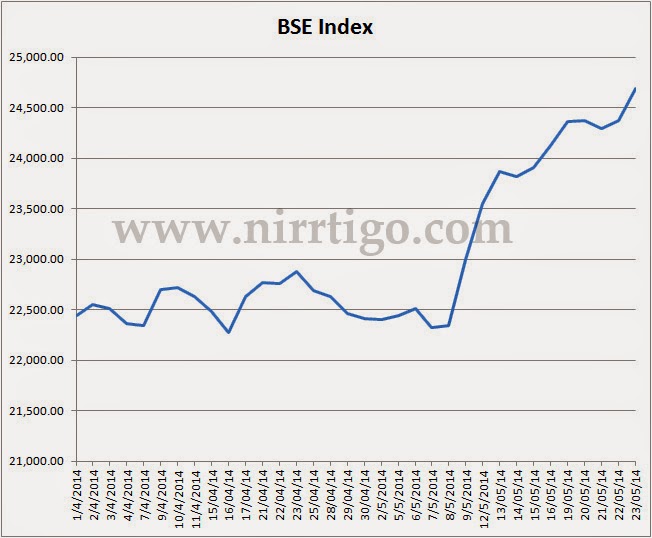
Now that, Elections are done with, what is the current state of mood in the country? Prime Minister designate Narendra Damodardas Modi will take charge today 26th May 26, 2014. Does he posses the magic wand to cure all the ills plaguing the Indian economy today? Then, how the hell this mood and subsequently the economy will improve? What will be the trigger that will make fence sitting consumers to buy goods?  What will enable businesses to invest in new projects? Well, again, it’s that magic thing called “Mood”…and no, we are not talking about the Moods condoms…..what we are talking about is the feeling of optimism among countrymen. Has it changed already from pessimism to optimism? Stocks markets seems to suggest so….the sheer size of BJP led NDA victory has enthused the capital markets and according to some experts this could be the beginning of mother of all bull runs that this country has ever seen.


Why are stock markets so upbeat about Narendra Modi? Decisive; able administrator; and economic development are some of the adjectives that are used to describe him. In my opinion, however, it seems he wants to go down as the greatest political leader in India since Mahatma Gandhi; it is this urge or fire which is driving him. And this urge has resulted in a hope and this hope which spreads like a viral can create infectious optimism and excitement, consumers will again start purchasing, businesses will start new projects, and bureaucrats will become efficient.

According to Keynesian Economics, There are 2 aspects to revive a faltering economy, one is by increased government expenditures and lower taxes to stimulate demand and pull the economy out of the Depression, and the second is Animal Spirit.

Post 2008 world financial crisis, UPA-II under Manmohan Singh implemented only one aspect of Keynesian model by increasing government spending to boost demand. Which of course stretched the fiscal deficit and that resulted in high inflation and high interest rates after 2011. However, they overlooked or were incapable to raise public sentiments or hope. Result, According to Planning commission data, GDP grew by 8.59 % in 2009-10, by 9.32 % in 2010-11, and then started to come down to 6.21 % in 2011-12, 4.99 % in 2012-13, and in 2013-14 it is expected to be at 4.5%. Had they improved public sentiments, things would have been different today.

Modi Government has raised hopes but he has to ensure that these expectations are complemented by action on ground. Because, make no mistake, without any substantive action, hope will soon dither.

Will he be able to deliver and fulfill these expectations???


Have any Questions?

Thursday, May 22, 2014

Area and Unit Conversion Calculator

Author: Sachin Gupta | Find me on Twitter

When buying a piece of real estate such as land, apartment, or shop, we come across various kinds of area units. In some instances, we may know the conversion factor and for others we use our calculators.

Here we present a widget for you to convert areas from one unit type to another.


Have any Questions?