Showing posts with label NRI Remittances in India. Show all posts

Friday, January 8, 2021

Can an NRI Take Personal Loan in India?

Yes, NRI’s can take personal loans in India. The NRI personal loans are accessible from various banks in India. No matter what purpose is the loan offer, there are many prominent banks that offer personal loans to NRIs against fixed deposits while private part banks give NRI personal loans that might be unbound. In fact, the personal loans for NRIs are a decent alternative to get speedy financing for diverse prerequisites.

The NRI personal loans are intended to help Indians who are living abroad to profit from the advantages of a personal loan in India. Some of the most famous banks which provide loans for NRI are State Bank of India, HDFC Bank, ICICI Bank, Canara Bank, Axis Bank, Standard Chartered Bank, Citibank, etc.


1. Eligibility: 

  • There are some requirements an NRI is supposed to meet in order to qualify the process of getting a loan. They are:
  • The applicant applying for the loan should be a citizen of India.
  • The applicant must also be at least 21 years of age.
  • It is important for the applicant to be a professional with a consistent salary or to run a business and be self employed.
  • The salary or the income of the applicant should be enough to qualify for the loan.
  • A number of documents which are required to be submitted as a formality.


In addition to all these things, it is possible that there may be some additional criteria dependent on the bank rules. The best to gain a better understanding of all the prerequisites is to go through the website of the bank you’ve chosen and be clear about everything that is required to get a personal loan.


2. Documentation: 

  • Coming to the documents required for NRI loans, the process is pretty simple to get any other personal loan. Salary details and KYC details need to be shown while applying for a loan. If a person is an NRI then reports which affirm the residential status are also important. Other important things are a passport and a VISA of the country the candidate is living in currently. In addition to all these documents, some other important documents are:
  • A photocopy of passport and VISA of the candidate. 
  • A certificate of salary determining the name, date of joining, designation and compensation details in English. 
  • Bank statements of both domestic and International banks throughout the previous half year. 
  • In the event that the candidate isn't accessible in India when the application of loan is submitted, at that point a General Power of Attorney should properly bore witness from the Indian office of the NRI's occupant nation. In the event that the candidate is available in India, the Power of Attorney can be privately legally approved. 
  • A duplicate copy of the appointment letter of NRI just as the contract.


You might be required to present some extra documents, so the best approach is to recheck the formalities of the bank that you have chosen for a personal loan.

3. Personal loans for NRIs: 

There are many banks in India that offer both rupee and foreign currency personal loans to NRIs who have FCNR or NRE term accounts. These personal loans are accessible against the sum in the FCNR or NRE accounts at highly competitive international rates. The loans are usually accessible up to 90% of the sum in the account with each bank having its own maximum limit on personal loan amounts.

4. Some highlights of personal loans are: 

  • The NRI loans have a wide scope of highlights as talked about below:
  • The NRI loans are actually accessible for a higher amount of money. 
  • The rates of interest involved in these loans are pretty competitive.
  • Time frame involved in the reimbursement of these loans ranges between one year to as long as five years.
  • An NRI can get a loan to fulfill almost any purpose.


5. Advantages of NRI loans:

  • The NRI personal loans offer many advantages of quick financing and many other things, for example,
  • Simple financing for individual credit prerequisites. 
  • The loans can be obtained from many other banks of your choice. Each bank has its own rules and advantages.
  • Extremely simple documentation and the application process. 
  • Bother free and quick preparing of all the important applications. 
  • The loans are accessible for both the salaried employees and people who are self employed.

This is a guest post by Shipra Aggarwal

Monday, April 20, 2020

How can Indian Real Estate Developers reach out to NRIs and target Overseas Indians?

Author: Sachin Gupta | Find me on Twitter

Real estate is an extremely important industry in the growth of Indian economy. The sector contributes about 6% to the nations’ GDP. The sector is also the second largest employer of labor (formal and informal) behind agriculture.

Real estate developers buy land from the city authorities or directly from the farmers/landowners. Once the land acquisition process is complete and titles are transferred in the name of the developer, the construction work starts. What kind of development will take place on a given plot of land depends on the market conditions. A developer can develop commercial or residential buildings based on the market elements of demand and supply.

The next step for the developer is to sell or lease the project to investors who are willing to use it for their end-use or for investment purposes. When market conditions are not favorable; it becomes extremely difficult for the developer to clear the unsold stock of inventory and that seems to be the case today in India. About 7.6 Lacs of housing units were unsold at the end of June 2014. And new project launches have been greatly reduced.

In this scenario, what can a developer do? Wait for the economic conditions to improve? Wait for the interest rate cuts? Wait for the improvement in job market? No doubt, all of these factors will certainly help the developer in clearing off the existing inventory; however, real estate developers can still tap into the highly lucrative Overseas Indians market.

This is a massive market with a population in excess of 21 million. The market constitutes of Non Resident Indians (NRIs), Person of Indian Origin (PIO), and OCI.


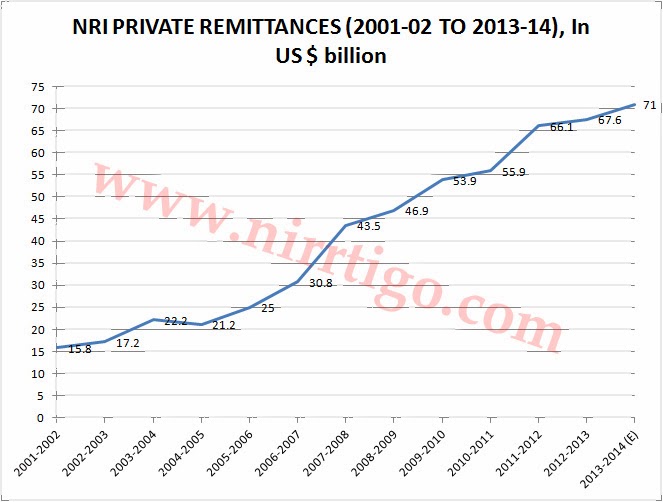
In 2013 alone, Private remittances from overseas Indians into India stood at whopping 71 Billion US $, the largest for any single country in the world.

Where are they investing? A closer look at the RBI data reveals preference for NRE/NRO accounts.


What can Real estate developers do to tap into this segment of the market?

A well thought out strategy is based on 4 principals

  1. Customers
  2. Product or services
  3. Region
  4. Channels


Having identified the customers (overseas Indians), the next step for real estate developers is to pay attention to the behavioral patterns of Overseas Indians. What kind of home sizes they prefer? What are the amenities that they demand? Who will take care of their apartments in their absence? Are there professional Property Management Companies in Delhi NCR and other parts of the country to provide NRI audience with apartment management services? What kind of on-site infrastructure they desire, etc. etc. A well prepared survey can help real estate developers in decoding the behavioral patterns of NRI audience.

After studying the behavioral patterns, the product (homes) can be conceptualized and sold in chosen regions. The next challenge is the choice of channels to reach out to NRI audience?

  • Web:
Use of web to reach out to NRIs is an inexpensive approach, but it is too generic and crowded in nature. However, it helps in creating awareness about the developer and the projects. If combined with other channels such as local brokerages and property shows, significant results can be achieved.

  • Partnership with local brokerages:
NRIs still transact through Indian Channel Partners and some international channel partners (Brokers of Indian origin settled abroad). A real estate developer can tie up with a few local channel partners (brokers) in the respective countries and had them invite their customers. However, not all real estate developers can successfully do it because of limited brand exposure and competition from other reputed developers.

  • Own office:
Having an office in a country can certainly help a real estate developer in reaching out to NRIs in that particular country. However, it is an expensive approach and developers with big pockets can manage to afford it. There are some developers who have set up their own offices in Singapore, Dubai, California, London, Malaysia, etc.

  • Property Shows:
Property shows or exhibitions are country specific in nature, wherein 40-50 real estate developers participate and showcase their properties to overseas Indians in that particular country. Past Indian Property Show in Singapore, Dubai, London indicates a footfall of 2500-3000 visitors a day. Even though, a developer may or may not make on the spot bookings, the exhibition certainly helps in brand building and that helps in future sales.

Having identified the NRI audience, a real estate developer must make the optimum use of different channels to reach out to this segment. One cannot simply afford to ignore this massive and profitable market segment. And the developer must continuously invest in reaching out to Overseas Indians.

NirrtiGo works with Indian Real Estate developers in order to reach out to overseas Indian community. NirrtiGo organizes Indian Property shows in overseas markets, utilize web based platforms, and create awareness on the vast property investment opportunities in India. Real Estate developers looking to target NRI markets can contact NirrtiGo for upcoming Indian Property shows in overseas markets at nirrtigo@nirrtigo.com


Have any Questions?

Saturday, February 28, 2015

Tax Exemptions for NRIs, PIOs, and the process of availing these benefits

Author: Sachin Gupta | Find me on Twitter

India is among the top beneficiary of remittances from Indian Diaspora across the world. In 2013, India topped the list in inward remittances from Indians across the world. The total money sent by Overseas Indians in 2013 alone stood at 71 billion US $.


This investment from Non Resident Indians, Person of Indian origins is an important cog in the growth and development of the country. Not just India, economies and administration around the world appreciate investments from overseas as an invaluable and sustainable feature of their economies. India is no exception and successive governments at the center have reached out to this huge audience by offering slew of measures ranging from tax benefits to relaxed visa facilities.

The Indian central government is continuously reaching out to Non Resident Indians (NRI), Person of Indian Origin (PIO), and Overseas Corporate Bodies (OCB) by offering several incentives and exemptions such as relaxations on income tax, wealth tax, gift tax, etc. At the same time, sops are also offered to NRI, PIO to invest in real estate sector and housing. Furthermore, recognizing that NRIs and PIOs pay taxes in two countries, the Government signed the Double Taxation Avoidance Agreement (DTAA) with several countries to lessen the tax burden. Incorporation of the Authority for Advance Ruling has also eased the process for tax payers by avoiding disputes with regards to assessment of Income Tax liability in case of Non-Residents and also specified categories of residents.

At the same time, one must also note that different state governments in India levy additional taxes but also offer exemptions offered by central government. How can an NRI, PIO avail these tax benefits?

Find below the detailed document.


Have any Questions?

Monday, June 9, 2014

Are property shows to reach out to NRIs really helpful to Real Estate Developers?

Author: Sachin Gupta | Find me on Twitter

We are all accustomed to seeing property show/exhibition advertisement in daily newspapers. This is one of the many ways in which real estate developers reach out to real people, it is claimed. While builders in India use multitude of channels to reach out to resident Indians including print, TV, radio, internet, SMS, and property shows, how do they reach out to Global Indians? Do they really care about investment from Global Indians? A cursory glance at the website of various builders will suggest that “YES”, they do care, because most of them have this wonderful “NRI Corner” tab on their websites.

In 2013, upwards of 70 billion US dollar were remitted by Global Indians into India. This is highest among all the developed or developing countries. Wooohooo….where is this massive money going? Which sector? We covered this in our previous post about NRI remittances. Although, there is no segmented data of how much of this money is going into real estate, yet it seems a significant amount.

However, most of the Non Resident Indians worry about the upkeep, and management of their property.  Many NRIs would like to invest in realty sector in prominent Indian cities such as Gurgaon, Noida, Mumbai, Bangalore, etc. For example, Ashish Sharma has a budget of around 1 crore and wants to invest in Noida. But Ashish is worried what will happen to his apartment since he does not have anyone to take care of the property. This is where Property Management Company in Noida can assist Ashish in managing his property. This way, not only will he be able to invest in Noida real estate, but at the same time, he will be able to generate monthly rental income.

Now, the question to be asked is how Global Indians decide on investing with a particular developer given the fact that most of them would not even know the names of more than 5 developers? Maybe by talking to their resident friends or family members or maybe by researching on internet…but these are all Maybes, we do not have any metrics or analysis which points to a particular channel or combination of some channels.

Real estate developers, it seems, adopt following 3 channels to reach out to NRIs:
  • Web

  • Property Shows in foreign countries such as Dubai, UK, USA, etc.

  • Sign up local brokerages


Let’s do the Pros and Cons of each channel:

Pros and Cons of Web:
By web, we mean, having a website, social media marketing, search engine marketing, search engine optimization, etc. 

Pros
  • Helpful in creating awareness

Cons
  • Non Segmented targeting
  • Generic in nature

Pros and Cons of Participating in Property Shows in Individual Cities:
Property shows are organized by an event management company. The show is typically organized in a big hall wherein 15-20 developers can set up their 3 feet by 3 feet table and address the people who visit that hall. In addition, there will be a banking partner and a local media company. That’s it. Some property shows may showcase 40-50 developers. And the show usually lasts for 2 days (normally weekend). But these shows are so boring that why would someone waste his/her entire day unless there is some networking opportunity.

A property show management company who organizes such events in Dubai is again organizing the event in the month of June 2014. In last 7 years, the company has done about 18 such shows with 150000 visitors. Let’s do some calculations…..150000 visitors for 18 shows…that means about 8333 visitors per show….or in other words 4150 visitors a day for a 2 days show. Hmm…..

Are property developers happy with these numbers? How much money did they spend for this kind of show? We don’t know….anyone with this number in mind, please comment :)

Anyways, in this business of explaining property shows, we forgot about Pros and Cons…here it is!

Pros:
  • Help in reaching out to limited people (not more than 8000 to 10000 for a 2 day property show). Hey, is it a Pro? Yea, something is better than nothing :)
  • Limited brand exposure. Obviously, fewer the people who visit the show, fewer the chances of brand recollect.

Cons:
  • City / Country specific
  • High cost of participation for the developer (participation fee + air ticket + hotel + daily allowances to staff)
  • A typical customer takes time to understand the market and trends. Therefore it is highly unlikely that he/she will buy the property on spot
  • You may go to London to sell your Mumbai Project, but how many people of Mumbai origin will visit you?

Why the hell then developers participate is such shows? Lack of creativity or maintaining the status-quo seems to be the answer. Let’s see, if something better than this comes up in future.


Pros and Cons of Signing up Local Brokerages:
Local brokerages are the local property agents of real estate developers in select countries. For example, ABC developer may take services of property agents in Singapore, Malaysia to sell his Chennai project.

Pros:
  • A local property agent has sound relationship with his/her clientele; therefore he/she is in much better position to realize the property transaction

Cons:
  • Limited channel partners internationally
  • Challenges of motivating them to sell your property


All in all, it is a complicated matter for real estate developers. And we are sure; they will sit in their board rooms and will come up with new ideas, strategies to reach out to NRI, PIO, and OCI audience. 

Meanwhile, don’t forget to tell us how much it costs to participate in an overseas property show with limited footfall and limited brand awareness :)

Cheers


Have any Questions?

Monday, March 3, 2014

Will falling Rupee lead to investment in real estate sector in India by Non Resident Indians? How can property developers tap this?

Author: Sachin Gupta | Find me on Twitter

Data Source: Reserve Bank of India, Ministry of overseas affairs

The Indian Rupee has fallen substantially against US dollar, and other international currencies. The value of one US dollar was Rupees 53.289 in Jan-2013, whereas in Jan-2014 it stood at 62.4768. It’s a fall of whooping 17.24% in one year, reaching a low of Rs. 69 odd.

During the course of this one year, at one point of time in August 2013, the rupee stood at 66.5742 against 1 US $. If not for the measures taken by RBI and finance ministry, the free fall of rupee would have continued. Exporters were happy but importers were crying and this had an adverse impact on current account deficit because of India being a net importer country.

Here is the sharp fall of rupee against US dollar in last 6 years.


Now, the question to be asked is if the fall of rupee results in increase in NRI remittances to India? And the answer is resounding ‘YES’. According to World Bank report, in 2013 international migrants (NRIs) will remit $71 billion of their earnings back to India, highest among all developing countries. "With the weakening of the Indian rupee, a surge in remittances is expected as nonresident Indians take advantage of the cheaper goods, services and assets back home.

Here is a look at what NRIs are remitting back to India on a yearly basis:


Now, the second question to be asked is, where is all this money going to? Is an NRI buying Property in India, or investing in NRE/NRO accounts, or investing in capital markets, or bond market, or in entrepreneurial activities? Although, there is little segmented data with regards to the share of each asset class, a quick look at the RBI database highlights that NRE/NRO accounts are the preferred choice by Non Resident Indians.

As per the RBI definition, Non-Resident Ordinary Rupee Account (NRO Account) may be opened / maintained in the form of current, savings, recurring or fixed deposit accounts. NRI/PIO may remit from the balances held in NRO account an amount not exceeding USD one million per financial year, subject to payment of applicable taxes. The limit of USD 1 million per financial year includes sale proceeds of immovable properties held by NRIs/PIOs. NRO (current/savings) account can also be opened by a foreign national of non-Indian origin visiting India, with funds remitted from outside India through banking channel or by sale of foreign exchange brought by him to India. Whereas Non-Resident (External) Rupee Account (NRE Account) may be in the form of savings, current, recurring or fixed deposit accounts. Such accounts can be opened only by the non-resident himself and not through the holder of the power of attorney. Accrued interest income and balances held in NRE accounts are exempt from Income tax and Wealth tax, respectively.

Whereas as per RBI definition; Foreign Currency Non Resident (Bank) Account – FCNR (B) Accounts are only in the form of term deposits of 1 to 5 years. All debits / credits permissible in respect of NRE accounts, including credit of sale proceeds of FDI investments, are permissible in FCNR (B) accounts also. Account can be in any freely convertible currency. Loans up to Rs.100 lakh can be extended against security of funds held in FCNR (B) deposit either to the depositors or third parties. The interest rates are stipulated by the Department of Banking Operations and Development, Reserve Bank of India. When an account holder becomes a person resident in India, deposits may be allowed to continue till maturity at the contracted rate of interest, if so desired by him.

There could be various reasons for preference of NRE/NRO accounts by NRIs ranging from volatility in stock markets, risks involved with entrepreneurial activities, low yield on bond market, relative safe nature of NRE/NRO accounts, and poor execution by real estate developers of their projects.


Why is real estate market in India not being able to attract NRI money to ease the current liquidity pressure? Our team debated on this issue and came out with 4Cs.


Cost - No Escalations – costs escalations during the course of the project construction has been a key detriment for NRIs wherein it has been noted that real estate developers escalate the cost of the project arbitrarily on account on various parameters such as rising labor cost, regulatory cost, and raw material cost. Why do we still observe a builder asking for additional funds from buyers for parking slots, development charges, and so on when those were not included in the builder buyer agreement at the time of selling of the project inventory? Why can’t there be transparency as far as project pricing is concerned? There needs to be more transparency in builder-buyer agreements.

Commitment to timeline – It is a common practice that developers sell their projects by claiming that they will deliver the housing units in 36 months at the time of agreement between them and the buyer. And yet, we have noticed umpteen numbers of cases where projects have been delayed by not just by 1 year but by more than 2-3 years. And in some cases, project delays have stretched to 4 years. Why can’t developers stick to their promise which they had made at the time of agreement? Or else, simply state the time it will take to develop the project (say 5 years). This matter needs to be addressed directly in contractual terms or through legislation.

Construction quality – With NRIs living in different parts of the world, it becomes difficult for them to verify the construction quality of the project? What are the construction materials being used? Will the specifications and amenities be as per the builder buyer agreement? To overcome this, a 3rd party periodic construction quality check can be brought in.

Carpet area to sale-able area ratios – maintain a transparent mechanism to calculate carpet area and sale-able area. This is a regulatory function, that authorities need to address. 

Along with the 4 'C', An NRI also worries about who will manage or take care of his/her Property? Sumit Bhargava bought a 3 BHK in Gurgaon, but he had to relocate permanently to UK for his work. Since, there were no Professional Property Management Company in Gurgaon, Sumit eventually sold his apartment at lower rates.

It is widely believed that if real estate developers can focus on these 4Cs, then there is absolute certainty that NRI money will flow in property sector in India at a scale unprecedented in real estate history of India and eventually it can ease the pressure of liquidity on real estate developers, and for that matter speculators, investors, banks, and other financial institutions that finance this huge economic activity.

Are the developers listening??? Real estate developers can reach our team of professionals for advisory at nirrtigo@nirrtigo.com


Data Source: Reserve Bank of India, Ministry of overseas affairs


Create your free online surveys with SurveyMonkey , the world's leading questionnaire tool.

Appendix – I
As per the May 2012 estimates by Ministry of Overseas Indian Affairs, the population of Indians living abroad is 21.91 million. However, more than 50% of them live in high income countries and have been the major contributor to NRI money flowing in India. We present below the overall break-up of population of Indians living in high income countries:

  • United States of America (USA) – 2.25 million
  • United Kingdom (UK) – 1.5 million
  • United Arab Emirates (UAE) – 1.75 million
  • Singapore – 0.67 million
  • Saudi Arabia – 1.79 million
  • Malaysia – 2.05 million
  • Canada – 1 million
  • Australia – 0.45 million
  • And in other countries across the globe – 10.45 million

Total Population of Indians living abroad– 21.91 million


Have any Questions?